
The Leaky Bucket: How Small Businesses Lose Money and How to Fix It
And how to find the holes before they drain your business dry
Here’s a scene we’ve seen a hundred times. A local service business, let's say a med spa, looks great on paper. They're running Google Ads, their Instagram is busy, and the phone is ringing. But when the owner checks the numbers at the end of the month, they just don't add up. The schedule has empty spots, the money feels low, and they're left wondering, "Where are all the customers going?" The honest answer? They're slipping through cracks in the business's own sales process. This isn't bad marketing; it's a "leaky bucket," and it quietly drains 20-40% of potential money from otherwise healthy businesses.
Let's look at a common story. Take Sarah, who runs a busy med spa in a mid-size city. She has three treatment rooms, two great aestheticians, and a fantastic front desk person, Jess, who handles phones, bookings, and walk-ins like a pro. On the surface, business looks great. The waiting room is often full, her Instagram has 4,200 followers, and last month she spent $3,200 on Google and Facebook ads. Leads are coming in.
But every month, when Sarah looks at the numbers, they never quite match her effort. There are always too many empty spots on the schedule. The list of new clients feels smaller than it should. She keeps asking herself the same frustrating question: "I know people are interested. Where in the world are they going?"
The answer is a tough one that every small business owner eventually faces. Her bucket is leaking. A lot.
Understanding the Leaky Bucket Problem in Your Business
So, what exactly is this leaky bucket, and why is it so important for your business? Let's break it down.
What is the "Leaky Bucket" and Why Does it Matter?
The "leaky bucket" is a good way to describe a sales process with lots of holes. You pour leads in at the top—through ads, referrals, online searches, and social media—and you expect a steady flow of money to come out the bottom. But between that first pour and the final sale, many potential customers just disappear. The leak isn't one big problem; it's many small, often unnoticed drips that, over time, add up to a lot of lost money.
How Small Leaks Add Up and Hurt Your Bottom Line
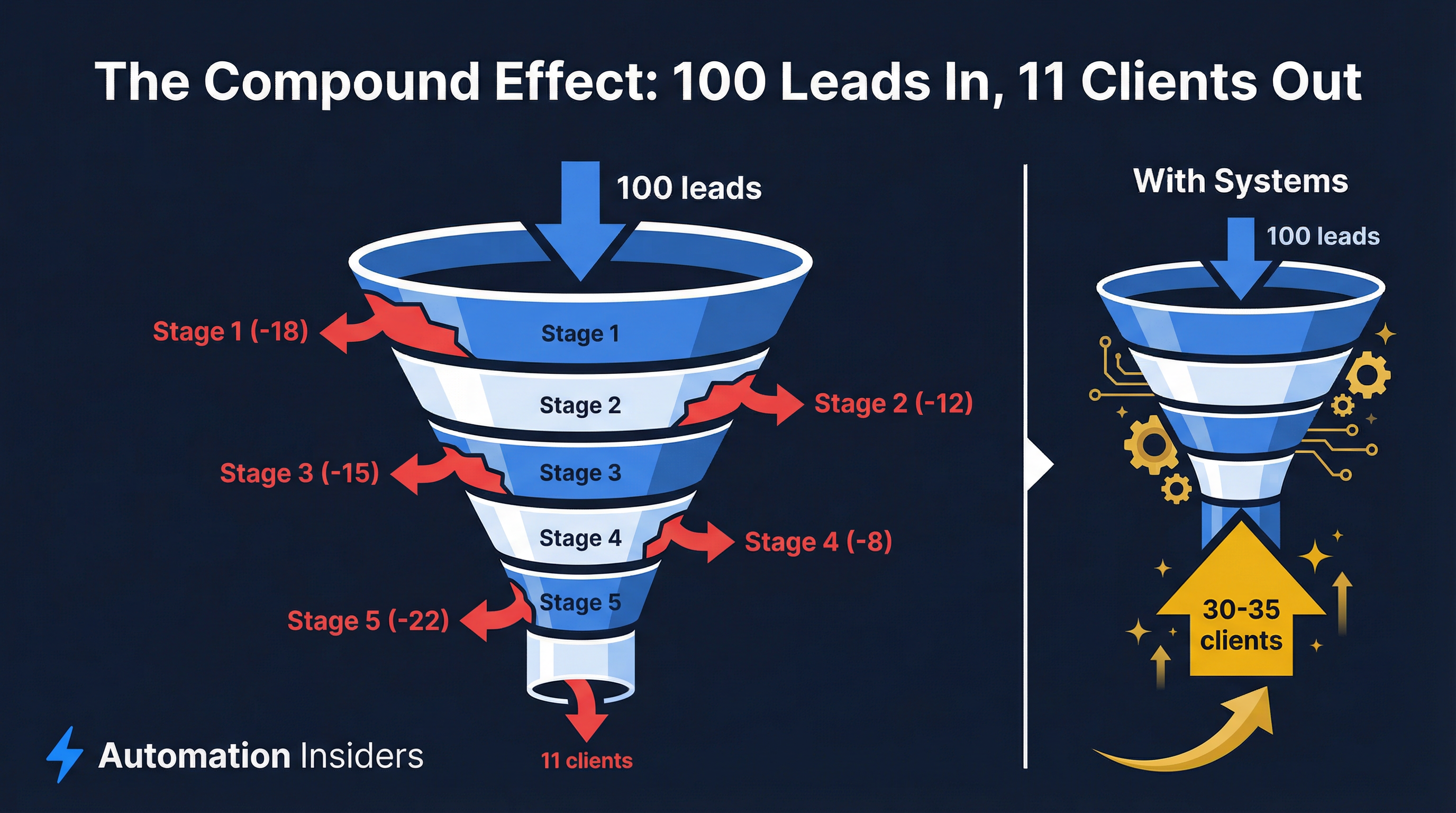
A single missed call might not seem like a big deal. Waiting 4 hours to reply to a web form might seem unavoidable. But these small leaks don't happen alone. They add up. A 10% leak at the start, plus another 15% leak in the middle, and a 20% leak at the end doesn't mean a 45% loss; it multiplies, greatly cutting down your total sales. This is why a business can feel busy but still not make much money. You're working hard to fill a bucket that's draining faster than you can pour water into it.
Change Your Thinking from "More Leads" to "Better Systems"
Most business owners focus almost entirely on filling the top of the bucket. When money is down, the usual reaction is always the same: "We need more leads." So they spend more on ads, chase more referrals, and do more marketing. But here’s the tough truth that successful HVAC companies and dental offices have found: for most small businesses, the real problem isn't how many leads they get. It's how many leads never make it through the sales process. Let's be clear: fixing the holes in your current bucket almost always makes you more money than just pouring more water into it. This article will show you the seven most common leaks, exactly where your money is disappearing, and how to set up systems to fix them for good.
Leak #1: Bad Lead Capture - The Opportunities You Never See
Before we even talk about the holes, let’s talk about the water itself. Sarah’s $3,200 monthly ad spend definitely gets leads. Her Google Ads bring in searches for “botox near me” and “facial treatments [city name].” Facebook campaigns reach her target customers. Her Instagram page is busy with DMs asking about prices.
But here’s what Sarah, like many business owners, doesn’t fully get: not all of that activity is actually being captured. Some of it just disappears before it even touches the bucket.
The Black Hole of Unanswered DMs and Late-Night Questions
Think about those direct messages that come in at 9 PM on a Tuesday. Long after Jess has gone home, these questions sit unanswered until the next morning. By then, the potential client has likely either booked with another spa or just forgotten they were interested. This is common for many local businesses. Online communication means potential customers expect fast replies. If you’re not there to answer, they’ll just go to the next option. This isn't just about losing one lead; it's about missing out on many such lost chances over time.
Website Contact Forms: Easy or a Sales Killer?
The contact form on your website is supposed to be easy, but it can quickly kill sales if you don't manage it right. For Sarah, the forms get filled out, but they go to a general email inbox that Jess only checks sometimes between her other tasks. Sometimes, it takes a full 36 hours for anyone to follow up. This delay is terrible. The urgent feeling a potential customer has when filling out a form quickly fades. By the time someone finally replies, the customer's interest has cooled, or they've already found another solution. This leak is especially sneaky because these leads never officially enter your customer system; they just… didn't make it.
How to Put All Your Incoming Messages in One Place for Best Visibility
To fix this, you need to see everything and reply fast. Every single way customers contact you—phone calls, web forms, direct messages, chat boxes, even social media comments—needs to be tracked carefully and, most importantly, replied to within a clear, short time. This means setting up systems that put all communications into one platform. Imagine a dashboard where every new question, no matter where it came from, pops up instantly, letting you or your team reply within minutes, not hours or days. This active approach makes sure no lead gets lost, getting you the most out of your marketing money. We’ll look closer at how important fast replies are in a moment.
Leak #2: Missed Phone Calls - The Most Expensive 30 Seconds in Business
Let’s stay with Sarah for a bit longer, because her experience with missed calls is sadly common for many small businesses.
The Real Cost of a Missed Call: More Than Just Lost Sales
On a typical Tuesday, Sarah’s front desk phone rings 22 times. Jess, doing her best, answers 15 of them. The other 7? Straight to voicemail. Of those 7, maybe 2 bothered to leave a message. The other 5 just hung up and—statistically speaking—most of them called the next med spa on Google. Ouch. This isn’t a “Jess problem”; it’s a basic system problem. One person simply can't answer every call while also checking people in, taking payments, and managing a busy schedule. It’s physically impossible.
But those 7 missed calls aren’t just small annoyances. They mean real money walking right out the door. Look at how much Sarah could be losing:
| What We're Measuring | Number |
|---|---|
| Incoming calls per month | 88 |
| Calls missed rate | 32% |
| Calls missed per month | 28 |
| Estimated sales rate (answered calls) | 22% |
| Potential new clients lost per month | ~6 |
| Average client lifetime value | $1,200 |
| Estimated monthly money lost | $7,200 |
These numbers, honestly, are low. A med spa with a $1,200 average client value that loses 6 potential clients every month is leaving a huge $7,200 on the table—month after month. Over a year, that’s $86,400 in money that was never made. Not because the marketing failed, but because the phone rang at exactly the wrong time. This is a big drain on profits that often goes unnoticed until it's too late. For more on this, you might find our article on HVAC missed call revenue loss helpful, as the ideas apply to many service businesses.
Why Voicemails Are a Black Hole for Potential Customers
We see a pattern: research consistently shows that businesses that miss calls without following up lose most of those leads for good. Most callers who get voicemail don’t bother to leave a message, and those who don’t leave a message rarely call back. Think about your own habits. When was the last time you left a voicemail for a business and patiently waited for a call back, especially if you were in a hurry? Today, customers expect instant answers. If they can't reach you, they'll just go to a competitor who is easier to reach. That's why relying on voicemail for missed calls is like throwing potential money into a black hole.
The Simple, Powerful Fix: Automated Missed Call Text Back
The fix isn’t necessarily hiring a second front desk person (though that definitely helps). The fastest and best fix is an automated text message the instant a call goes unanswered. Something like: “Hey, so sorry I missed your call! I’m with a client right now. What can I help you with?” That one message, sent within 60 seconds of a missed call, keeps the conversation going. It shows you’re responsive even when you’re busy. And, importantly, it turns a lot of those otherwise lost missed calls into booked appointments—all without anyone doing anything. This strategy works much better than traditional voicemail and can greatly cut down your missed call rate. Check out our missed call text back setup guide. If you want to see what this is costing your specific business, our Missed Call Revenue Calculator lets you put in your own numbers—call volume, miss rate, average job value—and instantly see the monthly and yearly impact in under two minutes. It’s a real eye-opener. You can also find missed call text back scripts and templates to get started fast, and understand the difference between missed call text back vs voicemail to make a smart choice. For more on available solutions, see our review of the best missed call text back apps for 2026.
Leak #3: Slow Lead Response Time - The 5-Minute Window That Defines Success
Imagine these two situations happening one after the other.
n, highlighting the stark difference that response time makes.The Psychology of Speed: Why Immediate Follow-Up is Everything
In the first scenario, a potential client searches “med spa near me,” clicks Sarah’s Google Ad, fills out the contact form, and receives a call back within four minutes. They are still at their desk, actively thinking about their needs, and the conversation flows easily and naturally. The urgency is fresh, and their attention is undivided.
In the second scenario, the exact same person fills out the same form. Jess, juggling a dozen other tasks, finally sees it three hours later and calls back. The person is now in a meeting. Jess leaves a voicemail. They play phone tag for two agonizing days. By the time they actually connect, the person has already booked with a competitor. Game over. The critical difference between these two scenarios isn’t the quality of the lead; it’s the sheer speed of the response. This demonstrates the profound psychological impact of immediate engagement when a prospect is in a decision-making mindset.
Data-Backed Impact of Response Time on Lead Qualification
The data on this is absolutely striking. Studies on lead response time consistently demonstrate that the odds of actually reaching a prospect plummet dramatically as response time increases—and the odds of converting them into a paying customer drop even faster. That 5-minute window isn’t some arbitrary number; it reflects the undeniable reality of how people shop for services today. When someone is actively searching and clicks your ad or fills out your form, they are in a prime decision-making moment. That moment, however, has a short half-life. The longer you wait, the more that initial urgency fades—and the more time your competitors have to swoop in and steal the business.
| Response Time | Likelihood of Qualifying the Lead |
|---|---|
| Under 5 minutes | Very high — prospect is still engaged |
| 5–30 minutes | High — still warm, may have moved on |
| 30 minutes – 1 hour | Moderate — starting to cool |
| 1–24 hours | Low — likely contacted a competitor |
| 24+ hours | Very low — most have moved on |
For Sarah’s med spa, the average response time to a web form submission hovers around 4 hours. This isn’t because Jess is negligent; far from it. It’s because there’s no system in place that immediately alerts her when a form comes in, and no clear protocol for how quickly it absolutely needs to be addressed. Our Lead Response Time Calculator can help you model precisely what faster response times would mean for your conversion rate and, your revenue. The math is often genuinely surprising—even shaving your average response time from 4 hours down to a mere 30 minutes can have a profoundly meaningful impact on how many leads you actually convert into paying clients.
From Hours to Minutes: Implementing a System for Rapid Response
The key to plugging this leak is implementing a system that ensures rapid response across all channels. This often involves integrating your website forms, social media messages, and phone systems with a centralized CRM or automation platform. When an inquiry comes in, an immediate notification should be sent to the appropriate team member, ideally triggering an automated initial response (like a text message) to acknowledge receipt and set expectations. This buys your team precious time to follow up personally while keeping the prospect engaged. By prioritizing and systematizing rapid response, you dramatically increase your chances of converting interested prospects into paying customers, turning a significant leak into a powerful stream of new business. This getting ahead of it is a cornerstone of effective 5-minute follow-up rule for response time and revenue strategies.
Leak #4: Inconsistent Follow-Up - Where 80% of Your Sales Are Hiding
Here’s a scenario that, sadly, plays out in Sarah’s business every single week, and likely in countless other small businesses as well.
The Myth of the "One-Call Close" and the Reality of Nurturing Leads
A potential client calls, chats with Jess, expresses keen interest in a Botox consultation, but then says she wants to “think about it” and promises to call back. Jess, being busy, makes a mental note to follow up “next week.” Next week comes, and goes. The client, who was genuinely interested, never hears back. Another lead, another lost opportunity. This isn’t a failure of intent; it’s a failure of system. The honest answer is that most small businesses simply don’t have a structured, automated follow-up process in place. They rely on memory, sticky notes, or the best intentions of an already overwhelmed team. The result? A massive percentage of perfectly good leads simply fall through the cracks, never to be heard from again. What we’ve seen consistently is that 80% of sales require 5 follow-up calls after the initial meeting. Yet, 44% of sales people give up after 1 follow-up. This gap is where your competitors are eating your lunch.
The Power of Automated, Multi-Channel Follow-Up Sequences
The solution is to automate your follow-up. This doesn’t mean impersonal, robotic messages. It means building multi-step, multi-channel sequences that nurture leads over time, delivering value and staying top-of-mind without requiring constant manual effort. Imagine a system that automatically sends a personalized email a day after the initial inquiry, followed by a text message two days later, and then a voicemail drop a week after that. Each touchpoint is designed to re-engage the prospect, answer common questions, and gently guide them towards the next step. This ensures that no lead is ever forgotten, and that your business is consistently nurturing opportunities even when you’re busy serving existing clients. This is where the magic of CRM and marketing automation stands out, transforming inconsistent efforts into a predictable revenue engine. You can explore our guide on setting up automated follow-up campaigns for small businesses to get started.
Leak #5: Poor Appointment Show-Up Rates - The Empty Chair Costing You Money
You’ve done the hard work. You’ve generated the lead, responded quickly, and even nurtured them through a follow-up sequence. They’ve booked an appointment! Success, right? Not so fast. The pattern we notice is that for many service-based businesses, a significant percentage of booked appointments simply don’t show up. This isn’t just an inconvenience; it’s a direct hit to your bottom line. An empty chair in a med spa, a dental office, or a consulting firm represents lost revenue, wasted staff time, and a missed opportunity to serve a client.
The Hidden Costs of No-Shows and Late Cancellations
The costs of no-shows extend far beyond the immediate lost revenue. There’s the staff time spent preparing for the appointment, the opportunity cost of not booking another client in that slot, and the general disruption to your schedule. For Sarah, a single missed Botox appointment could mean $500 in lost revenue and an hour of her aesthetician’s time. If this happens a few times a week, the numbers quickly become staggering. This is a leak that directly impacts profitability and can be incredibly frustrating for business owners who are working hard to fill their calendars.
Implementing Automated Appointment Reminders and Confirmations
The solution is surprisingly simple and effective: automated appointment reminders and confirmations. This means sending a series of messages—via text, email, or even automated phone calls—leading up to the appointment. A typical sequence might look like this: an immediate confirmation after booking, a reminder 24 hours before, and a final reminder an hour before. Each message should include clear options for confirming, rescheduling, or canceling. This proactive communication significantly reduces no-shows by keeping the appointment top-of-mind for the client and making it easy for them to communicate any changes. implementing a solid automated reminder system can reduce no-show rates by 30-50%, directly impacting your revenue and efficiency. You can find more information on effective appointment reminder strategies and templates in our comprehensive guide.
Leak #6: Inefficient Client Onboarding - The First Impression That Lasts
You’ve successfully converted a lead into a paying client. Congratulations! But the journey doesn’t end there. The onboarding process—the initial steps a new client takes with your business—is a critical juncture where many businesses unknowingly create new leaks. A clunky, confusing, or impersonal onboarding experience can lead to early client churn, negative reviews, and a failure to maximize the lifetime value of your new customer.
The Pitfalls of Manual Onboarding and Fragmented Information
For Sarah, onboarding a new client often involves a stack of paper forms, a lengthy in-person consultation, and a lot of repetitive information gathering. Clients might fill out the same details multiple times, feel overwhelmed by paperwork, or simply not understand the next steps. This manual, fragmented approach creates friction and can leave new clients feeling less than impressed. It also consumes valuable staff time that could be better spent on service delivery. The honest answer is that an inefficient onboarding process is a silent killer of client retention and can significantly impact your long-term revenue.
Streamlining Onboarding with Automated Workflows and Digital Forms
The solution is to streamline and automate your client onboarding process. This involves digitizing forms, creating automated welcome sequences, and providing clear, concise information about what clients can expect. Imagine a system where new clients receive a welcome email with a link to complete all necessary forms online before their first appointment. This can be followed by a series of automated messages introducing them to your team, sharing helpful tips, or even offering a special introductory offer. This not only creates a smooth, professional experience for the client but also frees up your staff to focus on delivering exceptional service. What we’ve seen consistently is that a well-designed automated onboarding process can significantly improve client satisfaction, reduce churn, and increase the likelihood of positive referrals, turning a potential leak into a powerful engine for growth. Explore our resources on automated client onboarding what actually works and tools to get started.
Leak #7: Lack of Client Reactivation - Leaving Money on the Table
Even with a perfectly plugged bucket, there will always be clients who, for various reasons, become inactive. They might have completed a service, moved away, or simply gotten busy. The leak here isn’t about preventing them from leaving; it’s about failing to bring them back. Many businesses focus so heavily on acquiring new clients that they neglect the immense potential of reactivating past clients, essentially leaving money on the table.
The Cost of Inactivity: Why Neglecting Past Clients is a Missed Opportunity
For Sarah, she has a database of hundreds of past clients who have visited her med spa at some point. Many of them haven’t been back in months, or even years. Each of these inactive clients represents a potential revenue stream that is currently untapped. Re-engaging a past client is almost always more cost-effective than acquiring a brand new one. They already know your business, trust your services, and have a history with you. Failing to reach out to them is a significant missed opportunity and a silent leak in your revenue bucket.
Automated Reactivation Campaigns: Bringing Past Clients Back to Life
The solution is to implement automated client reactivation campaigns. This involves segmenting your inactive clients and sending them targeted messages designed to entice them back. Imagine a system that automatically identifies clients who haven’t visited in six months and sends them a personalized email with a special offer or a reminder of your services. This can be followed by a text message or even a phone call from a team member. The pattern we notice is that these campaigns, when done consistently and strategically, can yield incredibly high returns, transforming dormant clients into active, revenue-generating customers once again. This getting ahead of it ensures that you’re not just filling your bucket, but also continually topping it up from existing resources. Check out our guide on effective client reactivation strategies and automated campaign examples.
The Takeaway: Plugging the Leaks for Sustainable Growth
The "leaky bucket" phenomenon is a pervasive challenge for small businesses, quietly siphoning off significant portions of potential revenue. However, by systematically identifying and addressing these seven common leaks—ineffective lead capture, missed phone calls, slow lead response times, inconsistent follow-up, poor appointment show-up rates, inefficient client onboarding, and lack of client reactivation—business owners can transform their operations. The honest answer is that implementing solid systems and automation in these areas is not just about stopping losses; it’s about unlocking sustainable growth and maximizing profitability. By focusing on "better systems" rather than just "more leads," you can ensure your bucket is not only full but also retains every drop of hard-earned revenue, paving the way for a thriving and resilient business. This article has provided a comprehensive overview of these critical areas, offering practical solutions and insights to help you build a more efficient and profitable business.
To find out where your pipeline is leaking revenue, the free Pipeline Leakage Calculator breaks down your loss by stage so you know exactly where to focus first.
For a practical system that plugs the missed call revenue leak — the most common and costly leak for local service businesses — read our missed call text-back guide. Use our missed call revenue calculator to quantify exactly how much that single leak is costing you each month.