
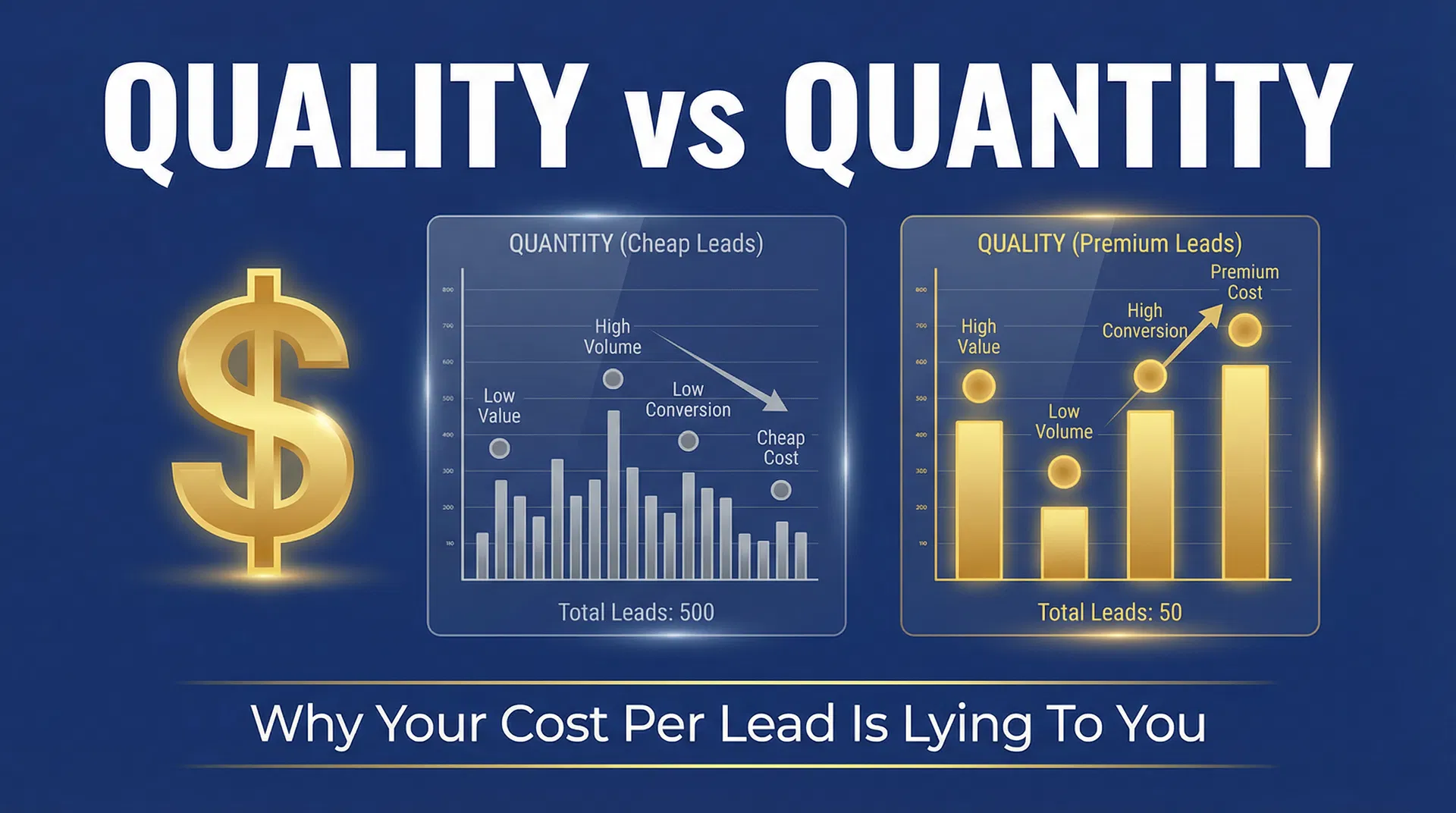
Your marketing budget is likely bleeding cash, and frankly, your cost-per-lead (CPL) report is probably lying to you. You might see a $15 lead and think you've hit the jackpot, especially when you compare it to the $200 inbound phone call your Google Ads campaign generates. But what if that seemingly cheap $15 lead converts at a dismal 2%, while the $200 phone call closes at a solid 42%? This isn't some far-fetched scenario; it's a common reality that exposes the fundamental flaw in focusing solely on CPL. Most business owners we talk to fall into the trap of chasing the lowest CPL, only to discover their sales team is drowning in low-quality leads that simply never convert. We're here to expose why CPL is often the most misleading metric in your marketing dashboard and, more importantly, show you how to calculate the number that drives your business growth: your cost per acquired customer.
The CPL Trap: Why Your Cheap Leads Are Costing You a Fortune
Let's be direct: not all leads are created equal. A low CPL can certainly feel like a win, but if those leads don't actually turn into paying customers, you're just throwing money away. Consider two local service businesses, both investing $3,000 per month on lead generation.
Business A: The Facebook Lead Form Fanatic. This HVAC company in Phoenix runs Facebook lead form ads targeting homeowners. They pay $18 per lead and generate 167 leads monthly. Their sales team diligently calls every single lead. After countless hours chasing cold contacts who barely remember filling out a form, they close a mere 5 deals—a 3% close rate. Their actual cost per acquired customer? A staggering $600. Ouch.
Business B: The Google Search Strategist. Meanwhile, a competing HVAC business focuses on Google search ads, targeting high-intent queries like "emergency AC repair near me." They pay a higher $145 per lead but generate 21 inbound phone calls each month. Their technicians answer every call, ready to solve an immediate problem. They close 9 of those calls—a 43% close rate. Their cost per acquired customer? A far more efficient $333. Now that's a difference.
Business A's leads look cheaper on paper at $18, but each customer ultimately costs them $600. Business B's leads are more expensive at $145, but their cost per customer is nearly half at $333. This illustrates a critical point: focusing on a low CPL without considering conversion rates is a surefire way to mismanage your marketing spend. It's a recipe for disappointment.
The Three Metrics That Actually Drive Profitability
If you're still fixated on CPL, you're missing the bigger picture entirely. The most successful local service businesses track three interconnected metrics that reveal the true health of their lead generation efforts. These aren't just abstract numbers; they're crucial insights into where your marketing is genuinely working and where it's falling short.
| Metric | Formula | Why It Matters to Your Business |
|---|---|---|
| Cost Per Lead (CPL) | Ad Spend ÷ Leads Generated | This tells you the initial cost of attracting a potential customer. It's a starting point, but by itself, it's incomplete. |
| Lead-to-Close Rate | Closed Deals ÷ Total Leads | This reveals the effectiveness of your sales process and, crucially, the quality of your leads. A high close rate indicates strong lead intent and/or a highly efficient sales team. |
| Cost Per Acquired Customer (CAC) | CPL ÷ Close Rate | This is the ultimate metric. It tells you the all-in cost to acquire a paying customer. This is the number that directly impacts your profitability and should absolutely be your primary focus. |
The relationship is straightforward, almost brutally so: CAC = CPL ÷ Close Rate. Let's say you have a $200 lead with a 40% close rate. Your CAC is $500. Now, consider a $20 lead with a measly 2% close rate. Your CAC jumps to $1,000. The "cheap" lead is actually twice as expensive when you measure what matters: a paying customer. This is precisely why understanding the nuances of lead quality is critical for your business.
Lead Quality Tiers: Not All Leads Are Created Equal
It's a common misconception that a lead is just a lead. In reality, lead quality varies dramatically, directly impacting your close rates and, your CAC. Based on extensive industry data from sources like HubSpot and Salesforce, we can categorize leads into three distinct tiers, each with different CPL ranges and conversion potential [1] [2].
Low-Quality Leads (Typical CPL: $5–$45)
These are often broad-audience, cold-contact leads. Think email opt-ins from a general interest ad, content downloads, or social media form fills targeting wide demographics. They are inexpensive to generate but demand significant effort to convert. Your sales team will spend a lot of time sifting through these. Average close rates typically range from 2–6%. These leads are best suited for high-volume, low-ticket offers or as a top-of-funnel strategy to build brand awareness, not for immediate sales conversions. For example, a local gym might use a low-cost Facebook lead ad to offer a free fitness guide, knowing most won't convert to a membership immediately but will enter their nurturing sequence.
Mid-Quality Leads (Typical CPL: $45–$250)
This tier includes targeted leads with some demonstrated intent. Examples include inbound form fills from your website (where the prospect actively sought you out), webinar registrations, or retargeted social ads shown to individuals who have already engaged with your brand. Close rates for these leads generally fall between 12–18%. Most local service businesses, like a dental practice or an auto repair shop, will find themselves operating heavily in this tier, where the balance between lead cost and conversion potential is a constant optimization challenge.
High-Quality Leads (Typical CPL: $150–$1,500+)
These are the gold standard: warm, verified, high-intent prospects. This category includes inbound phone calls from Google Search Ads, direct appointment bookings, or referrals. These individuals have often already decided they need your service and are actively choosing a provider. Their urgency and clear intent translate into significantly higher close rates, typically ranging from 35–50%. For most local service businesses, optimizing for these high-quality leads, despite their higher initial CPL, is the most profitable strategy. Imagine a roofing company receiving an inbound call after a storm; that lead is highly motivated and ready to buy.
The Hidden Costs of Chasing Cheap Leads
The CPL number on your dashboard is a mirage; it doesn't account for the significant hidden costs that erode your profitability when you pursue low-quality leads. These are the expenses that impact your bottom line, yet rarely appear in a simple marketing report.
1. Sales Team Time: Your Most Valuable Asset Wasted
Every minute your sales representative spends chasing a $15 lead that ultimately doesn't convert is a minute they're not engaging with a high-intent prospect. If your sales rep earns $25/hour and spends 45 minutes on a dead-end lead, that's $18.75 in labor costs per lead before you even consider the ad spend. Multiply that across dozens or hundreds of unconverted leads each month, and you're looking at thousands of dollars in wasted payroll. This isn't just about money; it's about the morale and efficiency of your sales team. You need them focused on closing, not cold calling.
2. Opportunity Cost: Missing Out on What Matters
When your team is bogged down with low-quality volume, your high-quality leads are going cold. This is a critical error. Research consistently shows that speed to lead is critical; companies that respond to leads within one hour are significantly more likely to qualify them than those that wait even two hours [3]. If your sales reps are tied up with prospects who barely remember filling out a form, they're missing the window to connect with the urgent, high-value leads who are ready to buy now. This directly impacts your revenue potential.
3. Brand Damage: The Unseen Erosion of Trust
Repeatedly calling or emailing individuals who have little to no interest in your services, or who filled out a form by accident, creates a negative brand impression. In local service industries like plumbing or chiropractic, where reputation and referrals are the lifeblood of your business, this is a real and tangible cost that never shows up on your marketing dashboard. You're not just losing a potential customer; you're actively creating a negative association with your brand in the community.
How to Calculate Your True Cost Per Customer and Maximize ROI
It's time to stop guessing and start measuring what matters. Here's a practical framework you can implement today to evaluate any lead generation channel and optimize for profitability, not just cheap leads:
Track CPL by Channel, Not in Aggregate: Don't lump all your lead costs together. Your Facebook ads, Google Search Ads, direct mail campaigns, and even referral programs will have vastly different CPLs. This granular data is essential for making informed budget decisions.
Implement Lead Source Tracking in Your CRM: This is non-negotiable. Every lead entering your system must be tagged with its original source. If your current CRM doesn't allow this, or if your team isn't consistently using it, fix this immediately. GoHighLevel's solid automation features make this simple, allowing you to automatically tag leads based on their entry point. Without this, you're flying blind.
Calculate CAC for Each Channel: This is where the magic happens. Divide the CPL for each channel by its corresponding close rate. This calculation reveals your true cost to acquire a paying customer from that specific source. For example, if your Google Ads CPL is $150 and your close rate is 30%, your CAC is $500. If your Facebook CPL is $20 but your close rate is 5%, your CAC is $400. Suddenly, the more expensive lead is actually cheaper in the long run.
Compare CAC to Customer Lifetime Value (LTV): A low CAC is great, but it needs to be evaluated against the lifetime value of your customer. If your average customer spends $4,000 per year and stays with you for 3 years, a $600 CAC is excellent. However, if your average job is $350 and customers rarely return, a $600 CAC is a disaster. Always view CAC in the context of LTV to understand your true return on investment.
Optimize for CAC, Not CPL: This is the golden rule. Once you have accurate CAC data for each channel, you can make strategic decisions. If a channel has a low CAC, scale it aggressively. If a channel has a high CAC relative to your LTV, cut it or re-evaluate your strategy—regardless of how cheap the leads might appear on the surface. Your goal is profitable customer acquisition, not just lead generation.
GoHighLevel: Your Ally in Winning the Quality vs. Quantity Battle
This is where a solid platform like GoHighLevel becomes essential for your local service business. GoHighLevel isn't just a CRM; it's an all-in-one marketing and sales platform designed to help you optimize for high-quality leads and maximize your CAC efficiency. Here's how:
- Automated Lead Source Tracking: GoHighLevel allows you to automatically tag every lead with its precise source. This is foundational for accurate CAC calculation.
- Missed Call Text Back: For local service businesses, inbound phone calls are often the highest-quality leads. GoHighLevel's Missed Call Text Back feature automatically sends a personalized text message to callers you couldn't reach, instantly re-engaging them and preventing them from calling your competitor. Quantify your losses with our Missed Call Revenue Calculator.
- Conversation AI (Voice AI Agent): GoHighLevel's Conversation AI (also known as Voice AI Agent) can handle initial inquiries, qualify leads, and even book appointments 24/7. This ensures no high-intent lead goes unanswered.
- Customizable Automation Workflows: Located in the Automation section, GoHighLevel's workflows allow you to build sophisticated follow-up sequences based on lead source, behavior, and qualification status. You can nurture low-quality leads over time, prioritize high-quality leads for immediate sales outreach, and automate appointment setting.
Across all industries, inbound phone calls from Google Search Ads consistently produce the lowest CAC for local service businesses—despite often having one of the highest CPL figures. Why? Because someone searching "emergency plumber near me at 11pm" has already decided they need a plumber. They are not browsing; they are buying. Your only job is to answer the phone or have an automated system like GoHighLevel's Conversation AI do it for you. This is precisely why missed calls are so costly for local service businesses. At an average CPL of $145–$360 for a search-generated phone call, every unanswered call is a direct loss of that amount—before you even count the revenue from the job itself.
Practical Takeaways for Your Business
The quality-vs-quantity debate isn't a debate at all when you measure correctly. Here's what you need to do this week to transform your lead generation strategy:
- Audit Your Current Leads: Pull your last 90 days of leads from your CRM. Tag each one with its source and calculate the close rate for each source. This exercise will be eye-opening.
- Calculate Your True CAC: Use our Blended CPL Calculator to model your true blended cost per lead across all your platforms. Then, using the close rates you just calculated, determine the CAC for each channel. This will give you the clarity you need to make informed decisions.
- Reallocate Your Budget Strategically: Shift your marketing budget toward your lowest-CAC channels. Even a 20% budget reallocation can dramatically improve your overall marketing ROI without increasing your total spend. Stop funding channels that deliver cheap, but unprofitable, leads.
The business owners who win at lead generation aren't those who find the cheapest leads. They are the ones who understand exactly what each lead costs them—all the way to the closed deal and beyond, into customer lifetime value. It's time for you to be one of them.
Conclusion: Stop Chasing Cheap Leads, Start Acquiring Profitable Customers
Your cost-per-lead is a critical metric, but it's only one piece of the puzzle. Focusing solely on a low CPL without understanding lead quality and conversion rates is a recipe for wasted marketing spend and frustrated sales teams. By shifting your focus to Cost Per Acquired Customer (CAC) and using powerful tools like GoHighLevel, you can transform your lead generation from a cost center into a profit engine. Stop letting cheap leads lie to you. Start making data-driven decisions that grow your business.
Ready to take control of your lead generation and optimize for profitable customer acquisition? Start your free 14-day GoHighLevel trial today and experience the difference a integrated marketing and sales platform can make for your local service business.
References
[1] HubSpot. (n.d.). Lead Generation Statistics. Retrieved from https://www.hubspot.com/marketing-statistics/lead-generation-statistics
[2] Salesforce. (n.d.). Sales Statistics. Retrieved from https://www.salesforce.com/news/stories/sales-statistics/
[3] Oldroyd, J. B. (2011, March). The Short Life of Online Sales Leads. Harvard Business Review. Retrieved from https://hbr.org/2011/03/the-short-life-of-online-sales-leads