
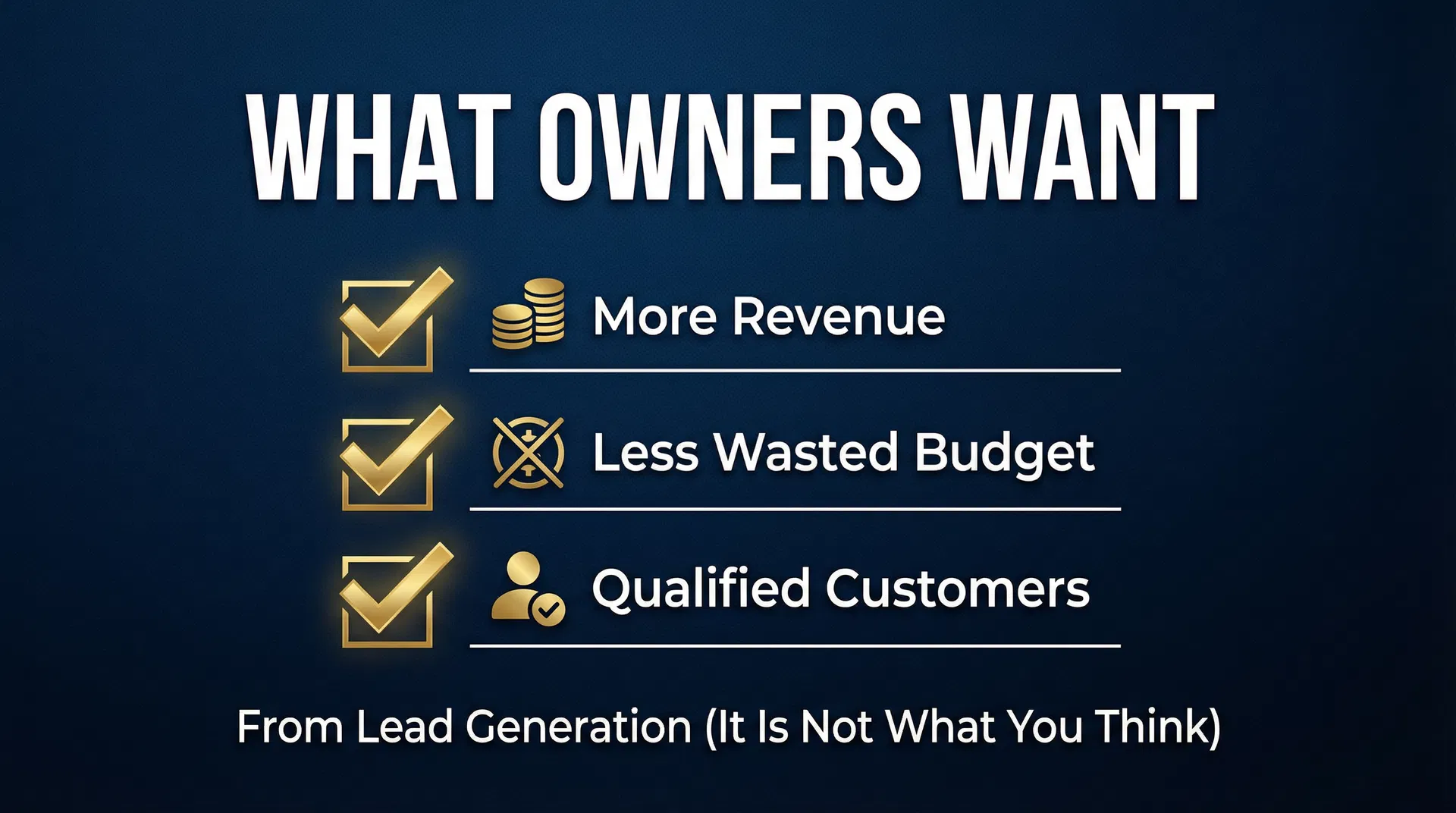
Your marketing agency promises you "more leads." But you, the business owner, want more customers. Let's be honest: these aren't the same thing. That gap between a raw lead and a loyal, paying customer? That's where most marketing budgets disappear.
This isn't some abstract business school idea. For a local service business—like your HVAC company, plumbing shop, or dental practice—it's the difference between a full schedule and a crew with nothing to do. You can easily spend five grand on Facebook ads and get slammed with tons of inquiries that never turn into sales. The real goal isn't just to make the phone ring; it's to make it ring with people who are truly ready to buy, without you having to chase every single one.
In this article, we're going to change how you think. Forget how many leads you get. We're talking about what really grows a service business: predictable, profitable customer acquisition. We'll show you the exact systems successful businesses use to get customers on autopilot. That way, you can spend less time struggling with your marketing and more time actually running your business.
The Three Pillars of Profitable Lead Generation
After working with tons of local service businesses, from busy HVAC shops to thriving dental practices, we've seen the same three main goals drive every successful marketing strategy:
1. Predictability: For every thousand dollars you put into Google Ads, you need a predictable number of booked jobs in return. An HVAC company in Phoenix, for example, needs to know for sure that their $5,000 ad spend in July will reliably bring in 25-30 high-value installation jobs. This kind of solid predictability lets you hire technicians and manage your cash flow with real confidence.
2. Profitability: It's not about how much money comes in; it's always about the profit. If you're spending $500 to get a customer for a $400 job, you're basically funding a very expensive hobby, not growing a real business. The big question isn't "how many customers did we get?" but "how much profit did each customer actually make after paying for the cost to get them?" For a dental practice, a new patient you get for $150 who then spends $3,000 over five years is way more valuable than a patient you get for $50 who only comes in once.
3. Automation: You want your marketing to work for you, not because of you. A well-built digital marketing system—with automated follow-up, smart lead nurturing, and easy appointment booking—can get customers while you're out on a job, sleeping, or even on vacation. Imagine a roofing company in Dallas: a lead fills out a form, immediately gets a text, then an email showing a relevant project, and finally a link to book an estimate. All of this happens without anyone on your team lifting a finger.
When you look at any way you get leads through these three lenses—predictability, profitability, and automation—it becomes super clear where to put your hard-earned marketing money. Stop chasing those quick, flashy numbers and start building a solid system that gives your business exactly what it needs.
Why Chasing "More Leads" Is a Trap for Your Business
The "more leads" idea sounds great; it feels like you're making progress. It's easy to measure, and it gives you a nice, big number to show off. But, only focusing on lead volume almost always creates problems that don't help your business grow long-term. This is exactly where many local service businesses fall into the cost-per-lead trap, only looking for the lowest price without thinking about the long-term value.
When you put lead volume above everything else, you usually end up with:
- Lots of leads, but not serious ones: Your team will spend most of their day chasing people who aren't ready to buy, leaving little time for truly interested prospects. A plumbing company getting 100 leads a week, but only 5 of those are actually looking for immediate service, is basically wasting 95% of their sales effort. That's a huge waste of money and time.
- Pressure to find cheap, useless channels: The cheapest leads are almost always the worst quality. Focusing on **cost-per-lead** without also looking at how many leads turn into customers is how businesses end up spending $3,000 a month on Facebook ads and closing zero deals. Sure, you might have a low CPL, but if your Cost Per Acquisition (CPA) is sky-high, you're just losing money.
- A sales team that burns out: Asking your team to call 200 cold leads a month just to close 4 deals is a sure way to have high employee turnover and low morale. It also costs way more in labor than most business owners realize—often much more than the ad spend itself. Your team's time is valuable; don't let it be wasted on endless time-wasters.
The other way, and the one we strongly recommend, is to focus on profitable customer acquisition: fewer leads, yes, but much better quality leads, leading to more sales, and a lower total cost per customer. This means you need to really understand your true cost-per-lead and how it affects how many sales you make.
Building a Predictable Lead Generation System
Most business owners we talk to struggle to get a steady flow of leads because they're running marketing campaigns instead of marketing systems. A campaign, by its nature, has a start, an end, and a set budget. When it finishes, the leads stop. When the budget runs out, the phone goes silent. This is exactly what causes that painful up-and-down cycle that hurts so many small businesses.
A system, though, is totally different. It's built to run continuously and get better over time. Here's what a good lead generation system looks like:
- Different channels working together: When Google Ads slows down, your email marketing steps up. When referrals are booming, you can cut back on paid ads. No single channel failing should ever shut down your whole business. For example, a smart chiropractic clinic might use Google Ads for people looking right now, Facebook for brand awareness and showing ads again to interested people, and email for keeping in touch with current patients and getting referrals. This varied approach makes sure you have a steady, reliable flow.
- Automated nurture sequences: Leads who aren't ready to buy today automatically get helpful content and good offers until they *are* ready. This brilliantly turns long-term prospects into customers without your sales team constantly having to do work. GoHighLevel's Automation section lets you build really smart workflows that send emails, texts, and even personalized voicemails based on what a lead does, making sure no lead ever gets forgotten.
- Consistent, multi-channel follow-up: Industry data clearly shows this: the average lead needs a huge 5–7 follow-up attempts before they finally buy. But most businesses give up after just 1–2. An automated follow-up system makes sure every single lead gets the full sequence, every time, across important channels like SMS, email, and even Conversation AI calls. This greatly increases your sales without adding any extra manual work.
- Constant measurement and improvement: A well-built system constantly tracks what's working and, just as important, what isn't, then adjusts itself automatically. You'll know your exact cost-per-lead for each channel, your precise conversion rates, and your overall Cost Per Acquisition (CPA). This lets you make decisions based on facts, not just gut feelings.
The Profitability Equation: LTV vs. CAC
How profitable your lead generation efforts are comes down to one absolutely crucial ratio: Customer Lifetime Value (LTV) ÷ Cost Per Acquired Customer (CAC). A good ratio is generally 3:1 or better. This means for every dollar you spend to get a customer, you should make three dollars in revenue from them over time. If your ratio drops below 3:1, you're either charging too little for your services or paying too much to get customers.
For most local service businesses, the LTV is often much higher than many owners first think, mainly because they often forget about:
- Repeat business: A loyal HVAC customer who gets a tune-up every year for ten years has an LTV that's easily 10 times their first job value. Don't just think about that first sale.
- Referrals: A truly happy customer who then refers two friends effectively doubles their LTV without you having to spend another dime on marketing. Building a good referral system isn't just smart; it's essential.
- Upsells and cross-sells: A customer who starts with a basic service and slowly buys more expensive things over time. When you accurately count the full LTV, a CAC that seemed expensive at first often becomes very reasonable. Think about a roofing company that spends $800 to get a customer for a $12,000 roof replacement. If that customer then refers two neighbors, and each of those also gets a $12,000 roof, the real CAC for the original customer drops a lot, and the LTV-to-CAC ratio shoots up. This, my friends, is exactly why understanding your true cost-per-lead and its big impact down the road is so incredibly important.
Optimizing Your Lead Generation Mix
Based on tons of data from many different industries, the lead generation mix that consistently gets the best results for local service businesses uses a smart, combined approach of different channels. The key is that all these channels must work smoothly together within an automated system:
1. Google Search Ads for Immediate Demand
People who are actively searching for your service right now are your absolute best prospects. Yes, they can be expensive per lead, but they are often the cheapest per customer because so many of them buy. This should be the foundation of your paid advertising. A local locksmith, for instance, should definitely focus on Google Search Ads for terms like "emergency locksmith near me" because those searchers need help immediately and are ready to hire.
2. Automated Missed Call Text-Back for Lead Recovery
The average local service business, surprisingly, misses 30–40% of all incoming calls. Think about that: each missed call is a lost lead you already paid for. GoHighLevel's Missed Call Text Back feature automatically sends a text message to anyone whose call you miss, easily turning a lot of those previously lost calls into booked appointments. All this, without spending any more money on ads. You can calculate your missed call revenue loss right now to see what this hidden problem is costing your business.
3. Email Marketing for Nurture and Retention
Email has the lowest cost-per-lead of almost any channel, and, when used well, gives you the best return on investment. It's not for getting cold new customers, but for expertly guiding warm prospects and keeping your current customers loyal. A regular monthly email newsletter sent to your customer list can generate repeat business and valuable referrals at a near-zero acquisition cost. Think of a smart med spa sending out monthly specials or insightful tips on skincare; this keeps them front-of-mind for existing clients and actively encourages future bookings.
4. Structured Referral Systems for High-Quality Leads
A meticulously structured referral program—one with a clear ask, a dead-simple process, and a genuinely meaningful incentive—can generate your absolute highest-quality leads at the lowest possible cost. Most businesses, have a referral system in theory, but rarely in actual practice. Implement a system where, for example, a delighted dental patient receives a $50 gift card for every new patient they refer who completes a cleaning. This formalizes and powerfully incentivizes word-of-mouth marketing.
Your Real Job in Marketing: Building the System
Your job as a business owner, when it comes to marketing, is not to endlessly run campaigns. The honest answer is, your job is to build a system that runs those campaigns—and then to relentlessly measure, optimize, and scale what demonstrably works. This demands three non-negotiable commitments:
1. Clear Metrics and Data-Driven Decisions
You absolutely must know your cost-per-lead by channel, your precise close rate by lead source, and your Cost Per Acquired Customer (CAC) for each channel. Review these critical metrics monthly, without fail. Make your decisions based on hard data, not vague intuition or what your competitor down the street seems to be doing. If your Facebook ads are showing a CAC of $1,200 and your Google Ads are clocking in at a lean $380, the answer is glaringly obvious—but it requires the discipline to actually act on that data.
2. The Right Tools for Automation and Tracking
You need a solid CRM that meticulously tracks leads from their very source all the way to a closed deal, an automated follow-up system that never sleeps, and a crystal-clear reporting dashboard that spotlights only the numbers that matter. GoHighLevel is purpose-built for this exact use case—it brilliantly combines CRM, marketing Automation, and comprehensive reporting into a single, powerful platform specifically designed for local service businesses. It hands you the power to implement all the sophisticated systems we've discussed here without the headache of juggling a dozen different software solutions.
3. A Willingness to Cut What Isn't Working
Perhaps the hardest part of marketing optimization is having the courage to stop doing the things that feel like they should work but simply don't. Don't get emotionally attached to a channel or a strategy if the data unequivocally shows it's underperforming. Be absolutely ruthless in cutting what doesn't genuinely contribute to predictable, profitable customer acquisition. This, in turn, frees up both budget and precious time for what does work, and works well.
Business owners who commit to building this kind of system stop asking, "How do I get more leads?" and instead start asking the far more impactful question: "How do I scale what is already working?" That, my friends, is the question that grows businesses and, crucially, gives you back your invaluable time.
Ready to build a marketing system that consistently delivers predictable, profitable customers? We encourage you to explore how GoHighLevel can centralize your lead generation, automation, and customer management. Start your free trial today and transform your business from endlessly chasing leads to confidently acquiring customers.
Use the Cost Per Lead Calculator to see your blended CPL across all platforms – and the Missed Call Revenue Calculator to calculate how much your current lead generation investment is leaking through missed calls.\n
To find out where your pipeline is leaking revenue, the free <a href="/tools/pipeline-leakage">Pipeline Leakage Calculator breaks down your loss by stage so you know exactly where to focus first.