
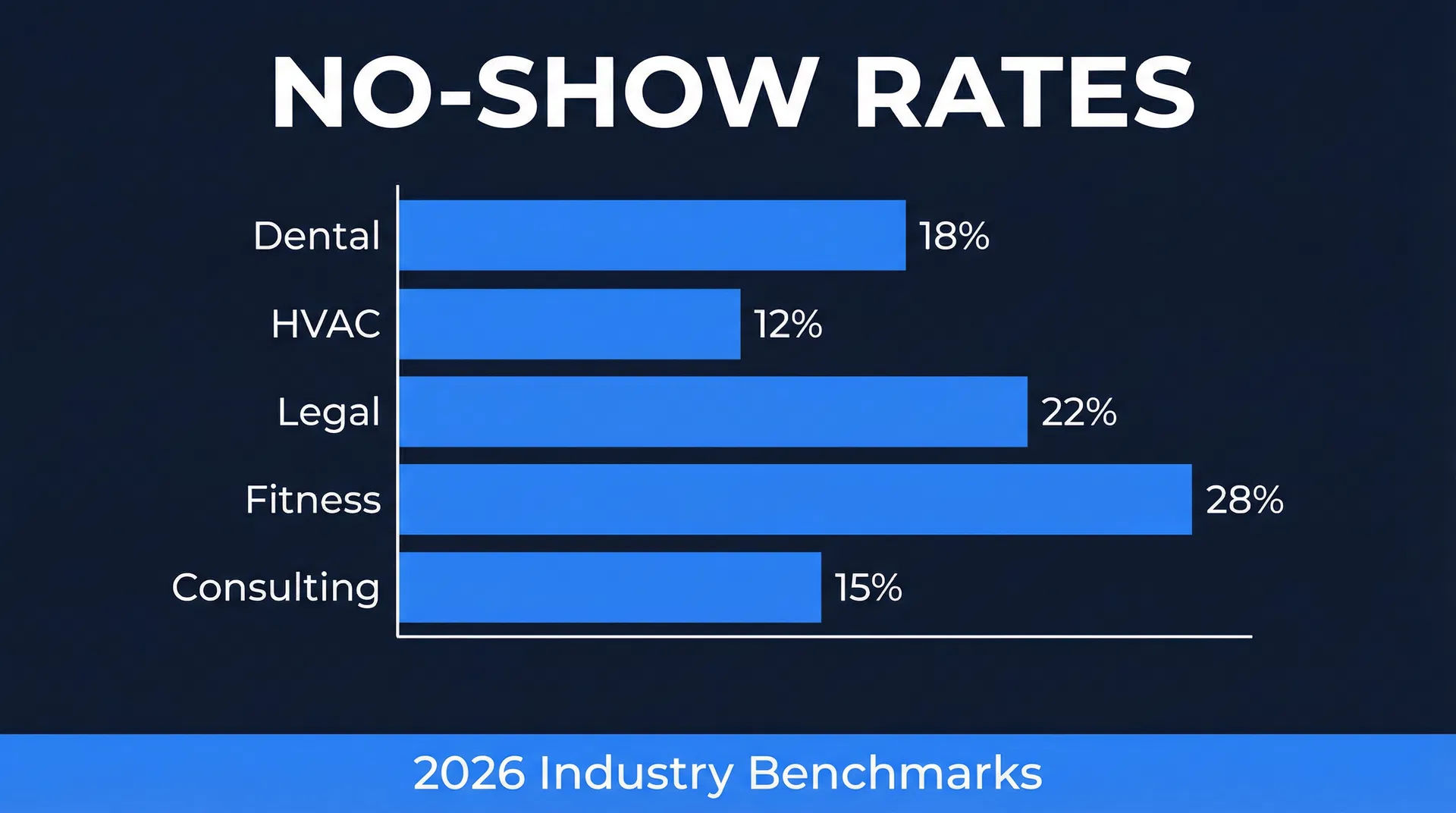
Imagine a bustling dental practice, fully booked, yet half its chairs sit empty. Or a high-end salon, stylists waiting, but clients are nowhere to be found. This isn't a hypothetical nightmare; it's the stark reality of 'no-shows' – the silent, insidious drain on profitability for countless appointment-based businesses. Unlike a sudden drop in sales or a scathing online review, no-shows don't typically trigger immediate alarms. They simply manifest as lost opportunities, invisible revenue that never materializes, compounding financial damage faster than most business owners realize. We've seen this pattern consistently across various sectors, and it begs a crucial question: how does your no-show rate compare to others in your field? Is a 10% rate merely the cost of doing business, or is a 20% rate a full-blown crisis? The honest answer, is that it depends entirely on your industry, your client base, and the robustness of your confirmation process. The benchmarks, we've found, vary far more than most people expect.
Why No-Show Rate Benchmarks Actually Matter
Knowing where you stand compared to your industry average does two critical things. First, it tells you if you've got a problem worth tackling or if things are already under control. Second, it gives you a realistic target. Let's be real: trying to hit 0% no-shows at a busy dental practice is a completely different beast than aiming for 0% at a law firm.
These benchmarks also completely change how you interpret your own data. A 15% no-show rate at a mental health practice? That's actually below average, representing solid performance. But that same 15% at an auto repair shop? That's a significant problem, and it demands immediate attention.
No-Show Rate Benchmarks by Industry
We've pulled these benchmarks from a mix of industry studies, deep dives into healthcare operations research, and extensive service business surveys. They represent the typical no-show rates for businesses that, frankly, use pretty standard confirmation practices—think one reminder call or email, no fancy automated follow-up.
| Industry | Average No-Show Rate | High-End Range | Notes |
|---|---|---|---|
| Mental health / therapy | 20–30% | Up to 50% | Highest rates in any service sector |
| Primary care / medical | 18–25% | Up to 40% | Varies by patient population |
| Dental | 10–20% | Up to 30% | Higher for new patients vs. established |
| Chiropractic | 12–18% | Up to 25% | Drops significantly with care plan buy-in |
| Legal consultations | 15–25% | Up to 35% | Free consultations have highest rates |
| Financial advisory | 10–18% | Up to 25% | Higher for first meetings |
| HVAC / home services | 8–15% | Up to 20% | Urgency-driven bookings have lower rates |
| Roofing / contractors | 10–18% | Up to 25% | Estimate appointments have high no-show risk |
| Auto repair | 5–12% | Up to 18% | Lower due to vehicle urgency |
| Hair salons / spas | 8–15% | Up to 22% | Last-minute cancellations often counted separately |
| Fitness / personal training | 10–20% | Up to 30% | Higher for first sessions |
| Real estate showings | 20–30% | Up to 45% | Among the highest outside healthcare |
| Tutoring / education | 10–18% | Up to 25% | Varies by age group and commitment level |
Now, these numbers are for businesses using basic confirmation practices. with automated reminder systems, most industries can slash their no-show rates by a solid 30–50%.
What Really Drives No-Show Rates Higher
Several factors consistently push no-show rates above the industry average, no matter what sector you're in. We've seen it time and again.
Booking lead time is, without a doubt, the single biggest predictor of no-shows. An appointment booked three weeks out? It's going to have a dramatically higher no-show rate than one booked just three days from now. The longer that gap between booking and the actual appointment, the more time a client has to forget, mentally reschedule, or simply find another option. Research from healthcare operations consistently shows that no-show rates roughly double for every week of additional lead time. That's a brutal truth.
Free or low-commitment appointments almost always have much higher no-show rates than paid ones. A free consultation, a free estimate, or a free first session carries almost zero psychological cost to skip. When there's no financial stake, the decision to bail requires almost no justification. This is precisely why legal consultations and real estate showings often have some of the highest no-show rates across all industries — the client literally has nothing to lose by not appearing.
Lack of confirmation friction is a counterintuitive, yet powerful, driver. When a client can book an appointment in 30 seconds with zero confirmation required, they've made a very low-commitment decision. But here's the kicker: simply requiring them to confirm the appointment — even just by clicking a link or replying "YES" to a text — creates a micro-commitment that meaningfully slashes no-shows. Studies from healthcare settings consistently show that requiring active confirmation reduces no-show rates by a solid 15–25%. It works.
New clients vs. established clients behave very, very differently. A client who's been coming to your plumbing shop for two years has a relationship with you and a track record of showing up. A new client? They have no relationship, no history, and absolutely no social cost to missing that appointment. Most businesses we talk to find their new client no-show rate is 2–3x higher than their established client rate. It's a stark difference.
Time of day and day of week also play a significant role. Monday morning and Friday afternoon appointments consistently see higher no-show rates than those smack in the middle of the week. Early morning slots (before 9 am) and late afternoon slots (after 4 pm) also experience elevated no-shows, especially for non-urgent services like a routine dental cleaning or a med spa consultation.
What a "Good" No-Show Rate Actually Looks Like
Let's be clear: the goal is not zero. Zero is simply not achievable in any appointment-based business, and honestly, chasing it will lead you to over-engineer your confirmation process in ways that just annoy your clients. The realistic goal? To be at or below the lower end of your industry's typical range.
For most local service businesses, a no-show rate below 8% represents excellent performance. A rate between 8–15% is manageable and, frankly, pretty typical. But a rate above 15%? That's a problem worth solving systematically. And if you're above 25%, that's a crisis that's likely costing you far more than you realize.
The most important benchmark, however, isn't the industry average — it's your own trend over time. If your no-show rate was 18% last year and it's 12% this year, that's meaningful progress, regardless of where the industry sits. But if it was 10% last year and now it's 15%? Something has definitely changed, and it's absolutely worth investigating.
The Financial Cost of Your Current Rate
Before you can even decide if your no-show rate is worth tackling, you absolutely need to know what it's actually costing you. The math is surprisingly straightforward, but most business owners we encounter have never actually done it. (For a full breakdown of every cost category — including the hidden ones most owners miss — see [The Real Cost of No-Shows: Beyond the Missed Fee](https://www.automationinsiders.com/blog/real-cost-of-no-shows-small-business).)
Here's how to figure it out: Take your average appointment value, multiply it by the number of appointments per month, and then multiply that by your no-show rate. That's your monthly no-show cost. Multiply by 12 for the annual figure. It's that simple, and often, that shocking.
Consider a dental practice seeing 200 patients per month with an average appointment value of $180 and a 15% no-show rate: 200 × $180 × 0.15 = $5,400 per month, or a staggering $64,800 per year. That's the [revenue that simply doesn't happen](/blog/real-cost-of-no-shows-small-business) because those chairs sit empty. Ouch.
Want to run these numbers for your specific business? The [[No-Show Cost Calculator](/tools/appointment-no-show) at Automation Insiders](https://www.automationinsiders.com/tools/appointment-no-show) will do it for you, including showing you the impact of automated reminders on your recovery rate.
How Automated Reminders Change the Math
The research on automated appointment reminders is remarkably consistent: they slash no-show rates by 30–50% across virtually every industry studied. The mechanism is simple, really — most no-shows aren't intentional. They happen because the client forgot, got confused about the time, or simply didn't have the appointment top of mind when the day arrived. Our [complete guide to automated appointment reminders](https://www.automationinsiders.com/blog/how-to-reduce-no-shows-automated-appointment-reminders) walks through the exact 3-touch sequence and message templates that produce these results.
A well-timed automated reminder sequence addresses all three of these causes head-on. A reminder 48 hours before the appointment catches clients who have completely forgotten. A reminder 24 hours before gives them ample time to reschedule if something has popped up. And a reminder 2 hours before? That catches those last-minute forgetters and gives them one final chance to confirm or cancel.
The key word here is "automated." Manual reminder calls are effective, sure, but they're incredibly expensive. A staff member spending 30 minutes per day making reminder calls is burning roughly 130 hours per year on a task that software can handle for $50–$100 per month. The ROI on automation is almost always positive within the very first month. It's a no-brainer.
GoHighLevel's appointment reminder system handles this automatically. Once you've got it configured, it sends that reminder sequence to every booked appointment without any manual intervention whatsoever. For a business bleeding $3,000–$5,000 per month to no-shows, recovering even 30% of that through automated reminders generates $900–$1,500 per month in additional revenue — all from a system that costs just $97/month to run. That's real money back in your pocket.
Industry-Specific Strategies That Actually Work
Different industries have, naturally, developed different approaches to cutting down no-shows, and the most effective strategies are often highly industry-specific. If your business takes both online and in-person bookings, the channel itself impacts your baseline rate — [online bookings typically produce 2x the no-show rate of in-person bookings](https://www.automationinsiders.com/blog/online-vs-inperson-appointment-setting-small-business), which means your benchmark target may need to be adjusted by booking channel. Something to keep in mind.
Healthcare practices, for example, have found that requiring patients to confirm appointments via text or automated phone call — rather than just passively sending a reminder — reduces no-shows significantly more. That act of confirmation creates commitment. Practices that demand active confirmation report no-show rates 20–30% lower than those that only send reminders. It's a small change with a big impact.
Service businesses like HVAC, roofing, and home services have discovered that sending a "your technician is on the way" message 30–60 minutes before the appointment dramatically reduces no-shows for in-home service calls. This message acts as both a reminder and a social commitment — the client now knows a real person is coming to their home, which makes canceling feel much more costly. It's brilliant.
Professional services like legal and financial advisory have seen no-show rates plummet when the confirmation message includes specific preparation instructions. "Please bring your last two years of tax returns" or "Please have your insurance information ready" creates a sense of preparation investment that makes showing up feel far more important. It builds value into the appointment.
Fitness and wellness businesses have found that no-show rates are lowest when clients have made a financial commitment — either a package purchase or a strict cancellation fee policy. Businesses with a 24-hour cancellation policy, enforced by a credit card on file, consistently report no-show rates 40–60% lower than those with no policy. Money talks, plain and simple.
Setting a Target and Measuring Progress
The most effective way to reduce your no-show rate is to treat it like any other critical business metric: set a specific target, measure it monthly, and diligently track the impact of every change you make. The most reliable path to hitting a lower benchmark is to build a systematic confirmation process, not just rely on ad-hoc reminders. See [How to Build a Bulletproof Appointment Confirmation System](https://www.automationinsiders.com/blog/appointment-confirmation-system-small-business) for a step-by-step framework that actually works.
Start by calculating your current rate. It's simple: Divide the number of no-shows in a month by the total number of scheduled appointments. If you had 200 appointments and 30 no-shows, your rate is 15%. Easy.
Next, set a 90-day target that's 3–5 percentage points lower than your current rate. This is totally achievable without massive process overhauls. Implement just one change — typically automated reminders are the best starting point — and then measure the result at 30, 60, and 90 days. Watch those numbers.
Once you've hit your first 90-day target, set a new one. Most businesses we've worked with find they can get their no-show rate down to a fantastic 5–8% within six months of implementing automated reminders and a confirmation requirement, no matter where they started. It's a proven path.
Bottom line: the businesses that fail to improve their no-show rates are almost always the ones that treat it as a fixed cost of doing business, rather than a solvable problem. But it *is* solvable. The tools are out there, the strategies are proven, and the ROI is crystal clear. The only real question is whether you're going to start measuring it and take action.
Use the [free No-Show Cost Calculator](https://www.automationinsiders.com/tools/appointment-no-show) to find out exactly how much your current no-show rate is costing your business every month.
Before investing in any CRM or automation platform, run the numbers with the free CRM ROI Calculator to see your projected return based on your current lead volume and close rate.